Capabilities and limitations of style transfer with CycleGANs for ring design automatic generation
Tomas Cabezon Pedroso
Javier Del Ser
Natalia Díaz-Rodríguez

Rendering programs have changed the design process completely as they permit to see how the products
will look like before they are fabricated. However, the rendering process is complicated and takes a
lot of time not only in the rendering itself but in the setting of the scene as well. Materials,
lights and cameras need to be set in order to get the best quality results, nevertheless, the
optimal output may not be obtained in the first render. This all makes the rendering process a
tedious process.
Since Zhu et al. introduced Generative Adversarial Networks (GANs) in 2014, they have been used to
obtain computer-generated data. From non-existing human faces to medical data analysis or image
style transfer. GANs have been used to transfer image textures from one domain to another, but
paired data was needed. When this same group introduced the CycleGANs, this all changed. CycleGANs
allow transforming one image from one domain to another, without the need of paired data.
This Work studies the possibilities of CycleGANs on style transfer from an initial sketch to a final
render. A process that is crucial in the automatic generation of ring designs as allows the costumer
to see the final products before buying.
The present Work sets a basis for future research, showing the possibilities of GANs in design and
establishing a starting point for new applications.
Results
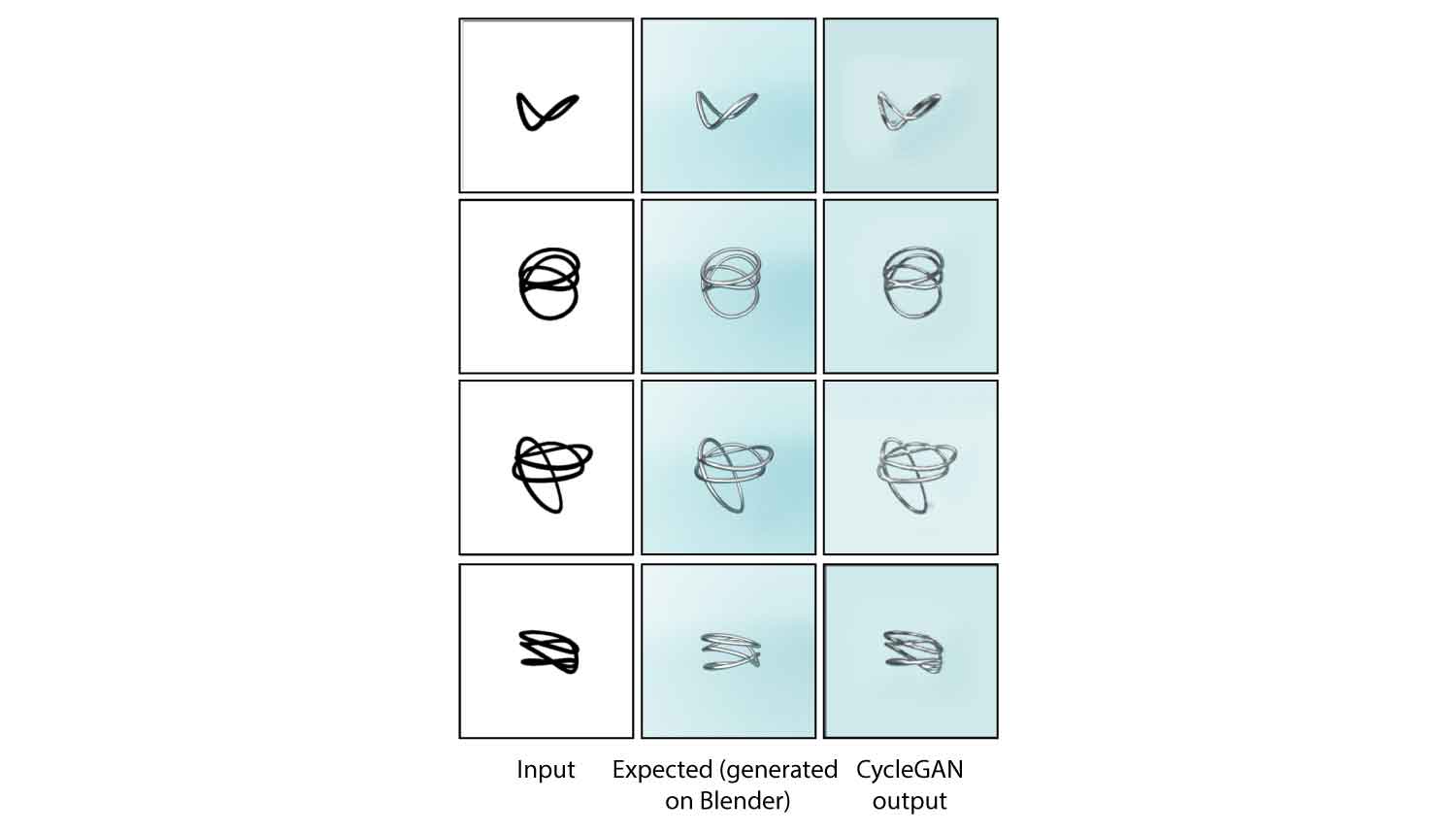
An example of how this CycleGAN could be implemented is bellow